

Environment and Biodiversity
Papua New Guinea is home to some of the most diverse ecosystems on the planet. Forests, wetlands and coastal environments support unique wildlife and provide essential resources for local communities, from food and water to materials used for housing and transportation.
PAPUA LNG’s activities traverse several areas of high biodiversity significance and conservation value. Protecting these ecosystems is therefore a central part of the project’s sustainable development approach.
TEP PNG in Papua New Guinea is committed to safeguarding biodiversity in areas where the company operates and the biodiversity values of the Upstream area of the Papua LNG Project. Papua LNG is committed to complying with Papua New Guinean legislation as well as leading international standards, including the International Finance Corporation Performance Standards and the Equator Principles.
Across its activities, the project implements measures to limit impacts on air, soil and water, manage waste and greenhouse gas emissions and protect biodiversity. The overarching ambition is to achieve Biodiversity Net Gain, ensuring that ecosystems are maintained and strengthened over the long term.
Biodiversity No Net Loss and Net Gain Strategy
To guide its environmental approach, Papua LNG has developed a Biodiversity and Ecosystem Services Policy, which provides the framework for protecting biodiversity and ecosystem services across the project area. Biodiversity refers to the variety of living organisms, while ecosystem services describe the benefits that ecosystems provide to communities and livelihoods.
The project’s Biodiversity and Ecosystem Services Policy outlines how impacts on biodiversity will be assessed and managed in the long-term. An important part of the Biodiversity Strategy is the offset program. This program was designed to balance the residual impacts associated with the construction of the Papua LNG Project with equivalent biodiversity gains. The Biodiversity Strategy was developed through consultation with key stakeholders including the Papua New Guinean Government, national and international NGOs, academic institutions and local communities.
The project’s Biodiversity and Ecosystem Services Policy is designed to meet the requirements of IFC Performance Standard 6, which covers biodiversity conservation, natural habitats, critical habitats, invasive species and protected areas. It aligns with the Papua New Guinean Government’s Protected Area Policy and the National Biodiversity Strategy and Action Plan. IFC, a member of the World Bank Group, is the largest global development institution focused exclusively on the private sector in developing countries.
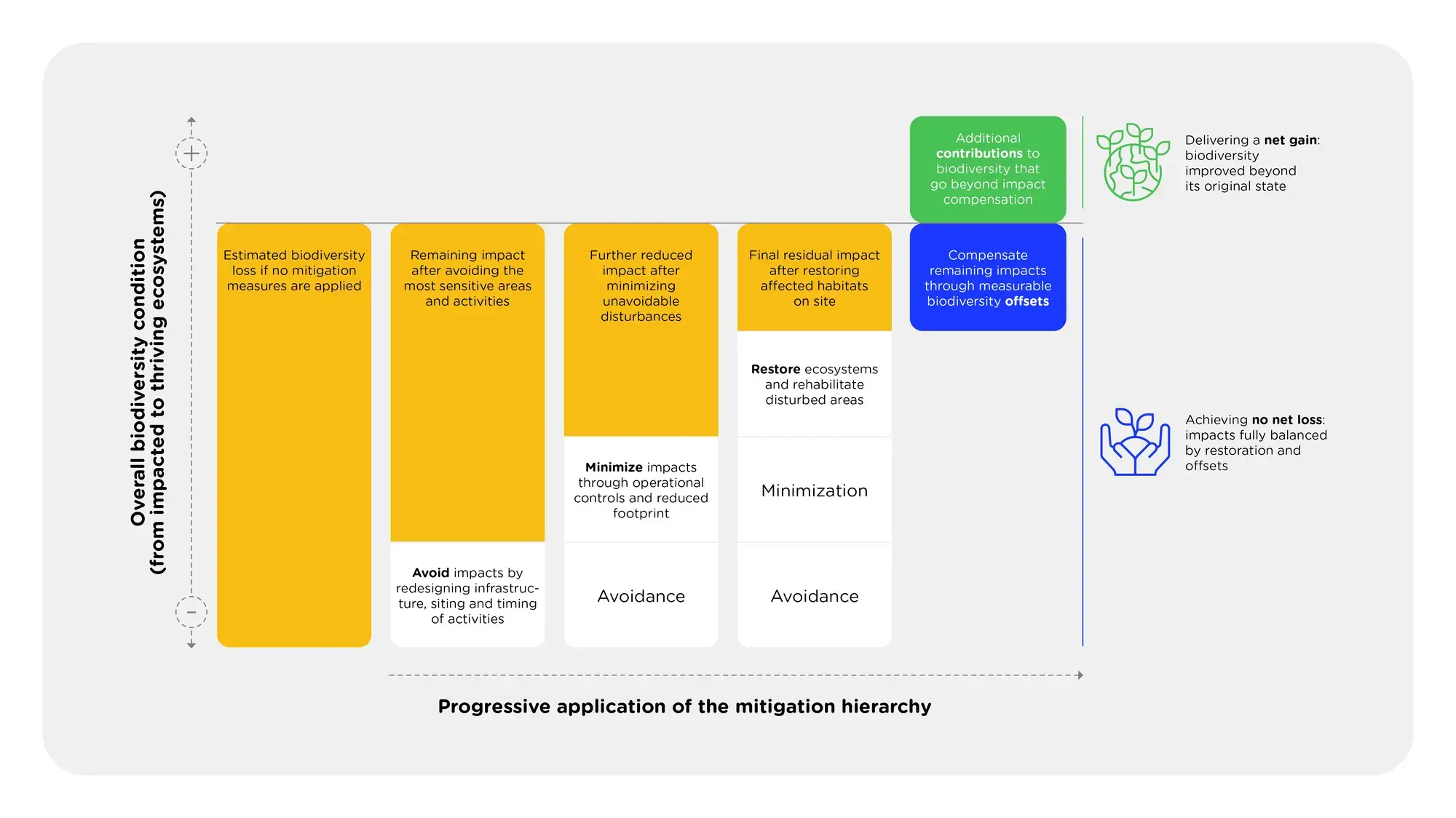
The strategy aims to achieve a net gain in biodiversity through the application of the internationally recognized mitigation hierarchy:
- Avoid impacts on biodiversity wherever possible
- Minimize unavoidable impacts
- Restore ecosystems affected by project activities
- Offset any remaining residual impacts
These actions are developed in consultation with local communities, NGOs and authorities. Contractors, partners and suppliers are required to follow the same standards to ensure that the project’s environmental commitments are applied consistently across all activities.
Implementation and Monitoring Program
To translate this strategy into concrete action, Papua LNG implements a Biodiversity Implementation and Monitoring Program.
The program focuses on areas with particularly high ecological value, including Hides Ridge and Lake Kutubu, and forms part of the project’s broader Environmental and Social Management Plan.
Through this program, the project:
- Implements biodiversity protection and mitigation measures
- Monitors ecosystems and habitats over time
- Verifies that environmental commitments are effectively applied
- Reports on environmental performance and progress
Monitoring programs allow the project to track environmental indicators and evaluate the effectiveness of its biodiversity management measures. This approach supports continuous improvement and helps ensure that biodiversity protection remains effective throughout the life of the project.
Zero Net Deforestation
Forests in Papua New Guinea are essential to biodiversity, local livelihoods and cultural identity. Protecting and restoring them is therefore a central priority for Papua LNG.
The Project has adopted a Zero Net Deforestation (ZND) commitment as part of its biodiversity management framework. Where forest clearing cannot be avoided, it is offset by restoring or establishing an equivalent or greater area of forest, ensuring no overall loss of forest cover.
Zero Net Deforestation activities are implemented in partnership with the Papua New Guinea Forest Authority, customary landowners and Incorporated Land Groups, focusing on Kuriva, Brown River and Boera. The programme is structured around four complementary focus areas:
Key achievements include:
- 1,000 hectares targeted for hardwood forest establishment
- 280 hectares of forest already planted with teak, Khaya and native species
- 60+ hectares of new plantations established during the latest planting cycle
- 3 hectares of coastal mangroves rehabilitated at Fairfax Harbour and Caution Bay
- 30 kWp solar capacity installed at the Koke Hanua mangrove nursery
Afforestation and reforestation
At the core of the ZND approach, this programme aims to establish at least 1,000 hectares of hardwood forest at the PNGFA Kuriva Forestry Station and on Varagadi ILG customary lands near Brown River.
Biodiversity protection
In 2024, TotalEnergies completed an independent Environmental Baseline Survey for the proposed forest reserve. Its findings are guiding a roadmap to secure long-term protection of the Veimauri Forest Reserve.
Mangrove rehabilitation and conservation
Mangrove ecosystems protect shorelines, support fisheries and provide critical habitats. Restoration efforts include the planting of hundreds of seedlings, including an initial 5000 seedlings at Fairfax Harbour. This work is supported by a cooperation agreement signed in May 2024 with PNG Ports Corporation Limited and Motukea International Terminal. At the Koke Hanua Mangrove Nursery, 60 solar panels (30 kWp) and battery storage were installed to power pumps and essential facilities.
New Guinea sandalwood conservation
This programme focuses on reintroducing one of the country’s most endangered tree species into its native savannah woodland habitat. Activities are carried out with local communities across Central Province, NCDC and Gulf Province.
Community participation is central to all programmes. In 2025, local residents actively contributed to planting and restoration activities, with women representing 20% of the workforce. A total of 50 community consultations and stakeholder engagements supported implementation and monitoring.
Environment programs and scientific research
Beyond restoration programs, Papua LNG also supports scientific research and biodiversity conservation initiatives.
Baseline studies and pre-clearance surveys conducted in the project area have already led to significant discoveries. Researchers have identified 20 frog species new to science, as well as 14 species that are endemic, restricted range, endangered or critically endangered.
To further support research and conservation, Papua LNG signed a memorandum of understanding with Nature Park in June 2022. This partnership focuses on scientific programs such as frog husbandry and genetic research aimed at better understanding amphibian biodiversity in Papua New Guinea.