

Applicable Environmental and Social Requirements
Papua LNG’s approach to Environmental and Social management is grounded in a clear commitment: to meet, and where possible exceed, the standards that govern responsible development. By combining national regulations, international benchmarks and internal requirements, the Project applies a structured and disciplined framework at every stage of its execution.
National Framework – Papua New Guinean Law and Requirements
Papua LNG is firmly anchored in the regulatory framework of Papua New Guinea. At its foundation is the Constitution of Papua New Guinea (1975), which recognizes customary laws and rights, including customary ownership of land. The Oil and Gas Act 1998 provides the primary legal framework governing petroleum exploration, development and production and sets out key provisions for licensing as well as the distribution of benefits to landowners and affected communities. Complementing this, the Land Act 1996 regulates land tenure and access, notably establishing that customary land cannot be sold and must be accessed through negotiated agreements with customary owners. The Environment Act 2000, overseen by the Conservation and Environment Protection Authority, defines the environmental approval process and ensures that potential impacts on ecosystems, water resources, biodiversity and cultural heritage are properly assessed and managed.
Papua LNG is firmly anchored in the regulatory framework of Papua New Guinea, including the Environment Act 2000 and the oversight of the Conservation and Environment Protection Authority. Other relevant laws cover issues pertaining to water resources, biodiversity protection and cultural heritage.
Compliance with national legislation is a fundamental requirement, guiding:
- Environmental and Social Impact assessments
- Permitting and regulatory approvals
- Stakeholder engagement and community consultation
Particular attention is given to Papua New Guinea’s unique context, where customary land ownership and community involvement are central, ensuring that local perspectives are fully integrated into the Project.
International Standards and Guidelines
In addition to national regulatory requirements, Papua LNG is committed to aligning with key international financial institution (IFI) standards and guidelines, including the International Finance Corporation (IFC) Performance Standards, the World Bank Group’s Environmental, Health and Safety (EHS) Guidelines, and the Equator Principles IV (EP IV). These globally recognized benchmarks provide a rigorous framework for managing environmental and social risks across eight key areas:
- Assessment and Management of Environmental and Social Risks and Impacts
- Labor and Working Conditions
- Resource Efficiency and Pollution Prevention
- Community Health, Safety, and Security
- Land Acquisition and Involuntary Resettlement
- Biodiversity Conservation and Sustainable Management of Living Natural Resources
- Indigenous Peoples
- Cultural Heritage
This framework supports a proactive and structured approach to risk identification and mitigation throughout the Project lifecycle.
Sponsors’ E&S Framework
The Project also benefits from the environmental and social frameworks of its sponsors, including TotalEnergies and its partners. These frameworks translate corporate sustainability commitments into concrete operational practices through:
- Internal policies and performance standards
- Technical guidelines and risk management tools
- Monitoring, reporting and continuous improvement processes
They ensure a consistent and high level of performance across all phases of the Project, often going beyond regulatory requirements.
Across all sponsors, these frameworks share common principles. They embed sustainability at the core of project development, with a focus on minimizing environmental impacts and supporting climate objectives, including decarbonization and Net Zero ambitions. They also place strong emphasis on health and safety, respect for human rights, and the delivery of social and economic benefits to local communities. In addition, they rely on robust governance structures to ensure strict adherence to internal policies and alignment with each company’s environmental and social commitments.
The links below provide gateways to the Project Sponsors’ internal environmental and social frameworks:
Respecting Human Rights
Respect for human rights is a core principle embedded across all Project activities, in line with the United Nations Guiding Principles on Business and Human Rights (UNGPs). These principles define the global standard and are structured around three pillars:
- Protect (State duty)
- Respect (Corporate responsibility)
- Remedy (Access to grievance mechanisms)
Papua LNG’s approach is structured around:
- Human rights due diligence to identify and manage risks
- Ongoing engagement with affected communities
- Accessible grievance mechanisms to address concerns
This reflects a clear commitment to respecting the rights, dignity and livelihoods of local and Indigenous populations.
Mitigation Hierarchy
The mitigation hierarchy is a core principle in environmental management, especially under IFC standards. As such, it is a central pillar of Papua LNG’s environmental management approach, ensuring that impacts are addressed in a structured and responsible way:
- Avoid impacts wherever possible
- Minimize impacts that cannot be avoided
- Restore or rehabilitate affected environments
- Offset residual impacts as a last resort
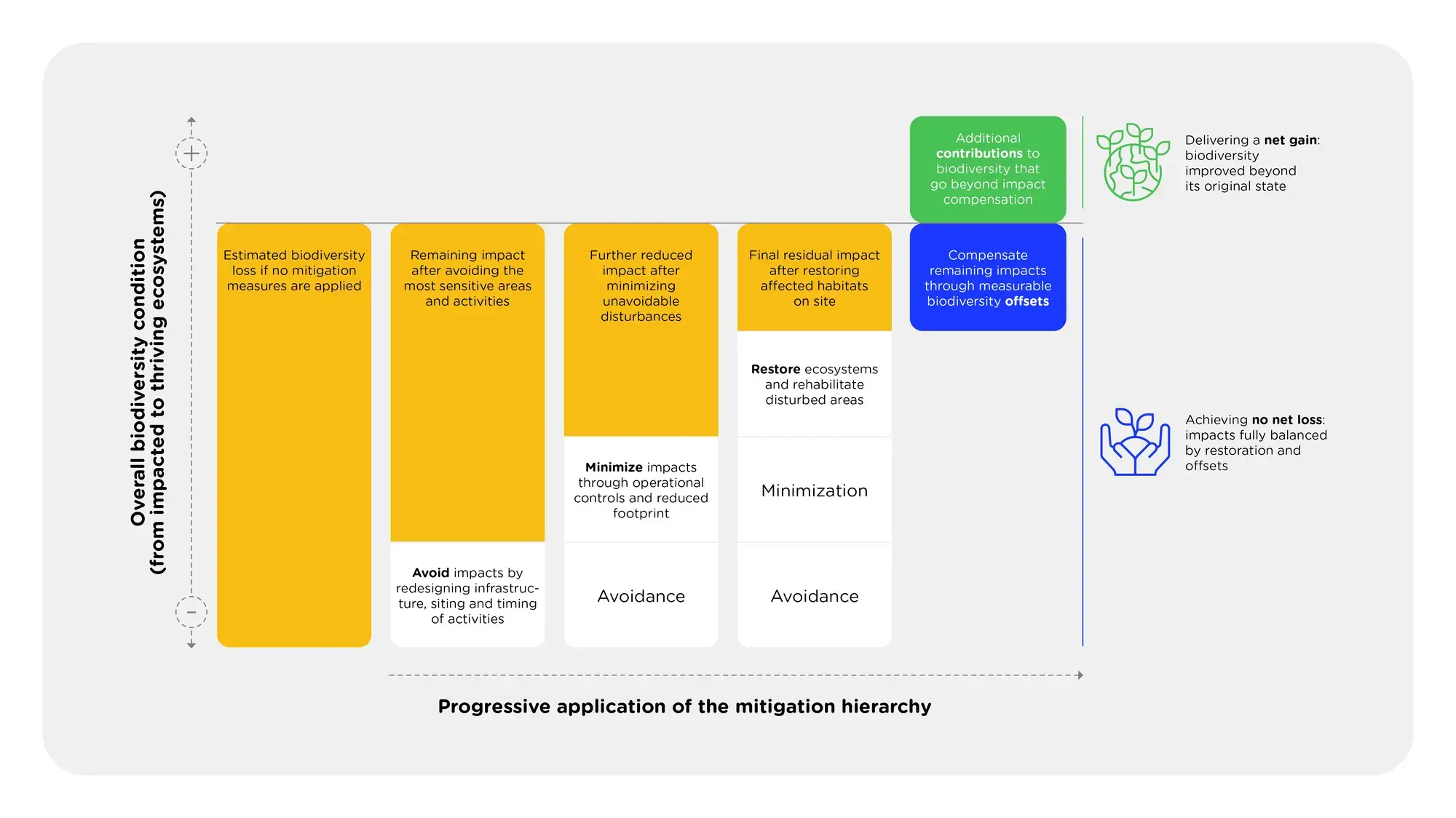
This approach ensures that environmental considerations are integrated into decision-making from the outset, particularly in relation to biodiversity and ecosystems.